
A Global Problem – Sacrifices Needed to Save The Earth
By the late 21st Century global acceptance jet engines added to the suffocation and destruction of the Earth was firmly established. Collective action was imperative and a public shift away from air travel followed in a bid to stop and reverse the world’s destruction. Enough was enough. Deforestation wiped out hundreds of species of plants, trees, animals and insects, many of which remained undiscovered before their demise. Advanced computer models generated hypothetical species which could have existed, given the local environmental factors, conditions and local evolutionary patterns. 3DVR (3D Virtual Reality) technology allowed people to enjoy what the forests could have looked like and olfactory nerve stimulators could generate the musky tropical smells within the synthetically generated habitat. This sense of loss fuelled the public outcry.
Travellers were no longer tempted by short breaks or transoceanic flights and reverted to transportation methods of their ancestors. The general public finally realised oil companies profited from conflicts by needlessly inflating prices, and not returning to reasonable rates after; they were fed up of being ‘ripped off’ and viewed as stupid by big businesses, retailers, airlines, governments and ‘idiot’ rulers of the larger nations. The aviation industry knew it needed to change and regain the trust of the travelling public if it was going to survive. But how?
It became fashionable to travel across Siberia with a team of Huskies. Similarly, in temperate and tropical climates, eco friendly transport alternatives were resurrected, such as camels, horses and pedal power. Employment laws changed to cater for these more environmentally friendly modes of travel. The average annual leave allowance became eight weeks, but only if employees agreed to use LTDs (Live Transportation Devices) to and from their destinations. But those who chose to continue with the environmentally destructive modes of transport such as aircraft and ocean liners could only look forward to two weeks’ worth of holiday and hefty environmental taxes. The general public’s priorities were shifting. They even had a motto:
“Get with it; save a Planet”.
Aircraft manufacturers realised collaboration and not competition was the key to survival. A pooling of financial resources and risk bought some extra time, but they were slowly dying. Aircraft were being decommissioned and scrapped at an alarming rate, leading to bankruptcy of airlines.
A new method of propulsion was needed and the focus remained on ultra efficient engines. These incorporated features such as extremely impressive high bypass ratios, additional compression stages and almost 100% efficient combustion chambers. But all of this innovation did not change fundamental facts; hydrocarbon fuels were still used, carbon dioxide produced, the Earth’s atmosphere was being destroyed and the planet continued to die. Fuel alternatives were considered and explored, but their use and manufacturing techniques were still harmful to the environment.
Attention shifted to airframe design in particular aircraft utilising ground effect. Ground effect is a phenomenon which affects all aircraft flying close to the ground within a 1.5 wingspan’s distance and if harnessed correctly can help improve lift and can reduce fuel burn. The very forces which keep an aircraft in the air; low pressure over the top of a wing and higher pressure underneath, become more pronounced. The high pressure under the wing provides a cushion for the aircraft resulting in additional lift, and in turn less fuel consumption. But again fuel was burnt to provide the propulsion. Also the hazards of flying so close to the ground soon became apparent. Many aircraft were lost and the public were not happy to travel in these aircraft which were susceptible to low level wind shear making it a hazardous venture flying so close to the ground.
Many scientists, aircraft designers, manufacturers and aeronautical engineers conceded defeat and without an appropriate clean fuel, which contained the same power producing qualities as Jet A or General Aviation fuel, flight as we had known it, would be impossible. It seemed all was lost. Even sustainable aviation fuel (SAF) couldn’t help.
An Unprecedented Solution To Polluting Aircraft – A New Way to fly
The solution came from an unlikely source. A group of aviation enthusiasts submitted a speculative paper to the newly formed JÖRD (Joint Outer space Redeployment Delegation). JÖRD’s philosophy and mission statement was to heal the Earth using the Earth. And this proposition did just that:
“Design and produce passenger carrying aircraft whose method of propulsion would be provided by a property of Earth which was present well before the death and decomposition of the dinosaurs and will remain plentiful for millions of years to come”
The proposed propulsion provider was the Earth’s magnetic field and this new development in aviation was named Fly By Flux.
Everyone who studied science or Physics learned of the effects on an electrical conductor as it cuts magnetic lines, or flux. Once the new concept was announced and backed by JÖRD, the collective global “oh yeah, I remember that” was almost deafening. Nearly everyone remembered the principle, but globally only a team of five people applied this ancient scientific principle to solve a modern day problem. The original discovery by Professor J A Fleming centuries previously eventually had a profound impact on the human race, as its application restored the ability to travel globally without the pollution and destruction suffered from carbon fuel burning engines.
How Was Fly By Flux Achieved and Applied to Global Aviation?
The principle used was the Fleming’s Left Hand Motor Rule. This simple yet powerful rule proved to be a saviour for those who still wanted to be able to fly to their destinations and for whom the 3DVR experience was a little too artificial.
To understand the principle, the index finger of the left hand is pointed forward as if pointing in a particular direction. The left thumb is pointed upwards as in the “thumbs up” position and the middle finger forms a right angle to the index finger in the horizontal plane. This three finger configuration will describe the movement of a conductor within a magnetic field.
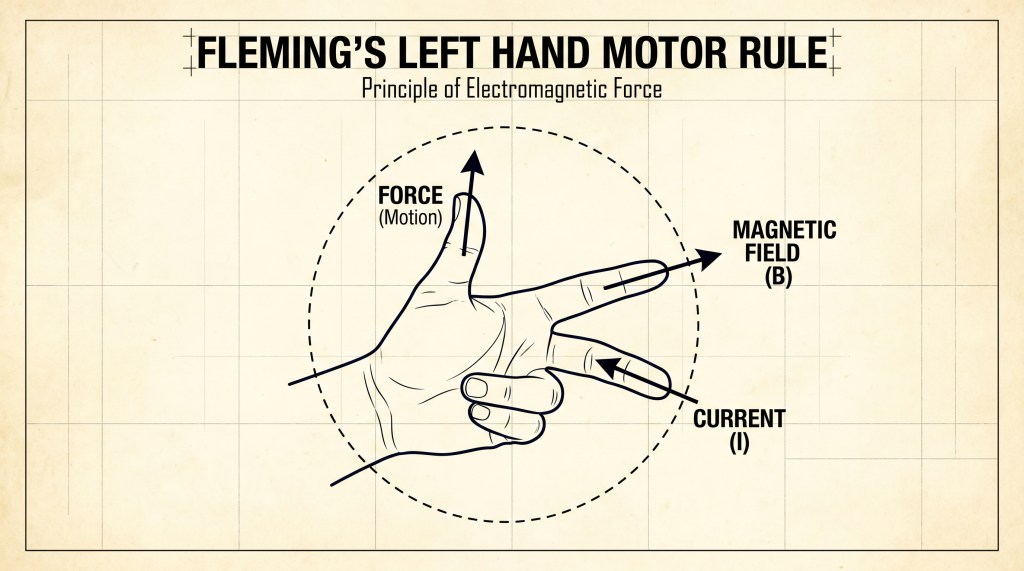
The thumb gives the direction of motion the conductor experiences, the index or first finger is aligned with the magnetic field and the second finger describes the direction of current through the conductor. The human hand’s motion is limited on the ground, however in a 3D environment such as the Earth’s atmosphere any orientation of this effect is possible.
Application of The Fleming Left Hand Rule in Aviation
As the Earth’s magnetic field flows North – South, the initial conclusion was only easterly or westerly flight would ever be possible. Also the field strength is of great importance; the stronger the field the greater the force and hence speed, which determined the aircraft’s lift and its ability to stay in the air. These aircraft were completely engineless, the Earth’s magnetic field was the “fuel”. The magnetic field produced by the Earth is relatively weak and was not strong enough to propel an aircraft through the sky for hours at a time. Also, as the motion of such a conductor is always perpendicular to the plane which contains both the current and field, this presented another problem. Aircraft have always needed to undertake manoeuvres in various orientations and configurations, in the 3 Dimensional environment that was the air.
How is the Earth’s Magnetic Field ‘Amplified’ to Support an Aircraft in Flight?
To overcome the relatively weak magnetic field of the Earth and to also ensure a very strong, concentrated and perpendicular field regardless of the aircraft’s orientation, the Teslator was developed, named after the Tesla, the unit of magnetic flux density. It was an ingenious device which used the latest micro electronic innovations to amplify magnetic flux. The microscopic Teslators are situated just under the aircraft’s skin. The proprietary design did something not often experienced in physics – it ‘generated something bigger from something smaller’. So a weak ambient magnetic field was turned into a highly concentrated field which became significant and allowed the principle to be harnessed for sustainable flight. The Earth’s magnetic field becomes every aircraft’s fuel; no need for hydrocarbon fuels, so the Earth gradually recovers and heals.


How Do Teslators Operate to Maintain an Aircraft’s Ability to Fly?
The design today in 2277 is still the same. Suspended on gyroscopically controlled gimbals, the Teslators ensure the resultant interaction maintains level flight when needed. Each Teslator also contains a seeking circuit which ensures best alignment with the Earth’s flux allowing the aircraft to perform any manoeuvre known to aviation. Once the gimbals align the Teslator, an amplification circuit boosts the magnetic flux strength 50,000 times and this interaction controls the airspeed for various stages of flight.
Teslators are self contained units, which reduces redundancy risks should one become redundant. Each aircraft is capable of flying with 25% of its Teslators inoperative. However, they were and still are such robust and reliable components failures are rare.
Fly By Flux aircraft wingtips are constantly maintained at opposite potential which ensures a constant current flows from port to starboard to ensure this “conductor” (the Fly By Flux aircraft) maintains forward flight. The opposite current created, as is the case with any conductor in such an environment feeds back into the Thrust Current Circuit and into the aircraft’s electrical systems.
New Aerodynamically Shaped Fly By Flux Aircraft Developed
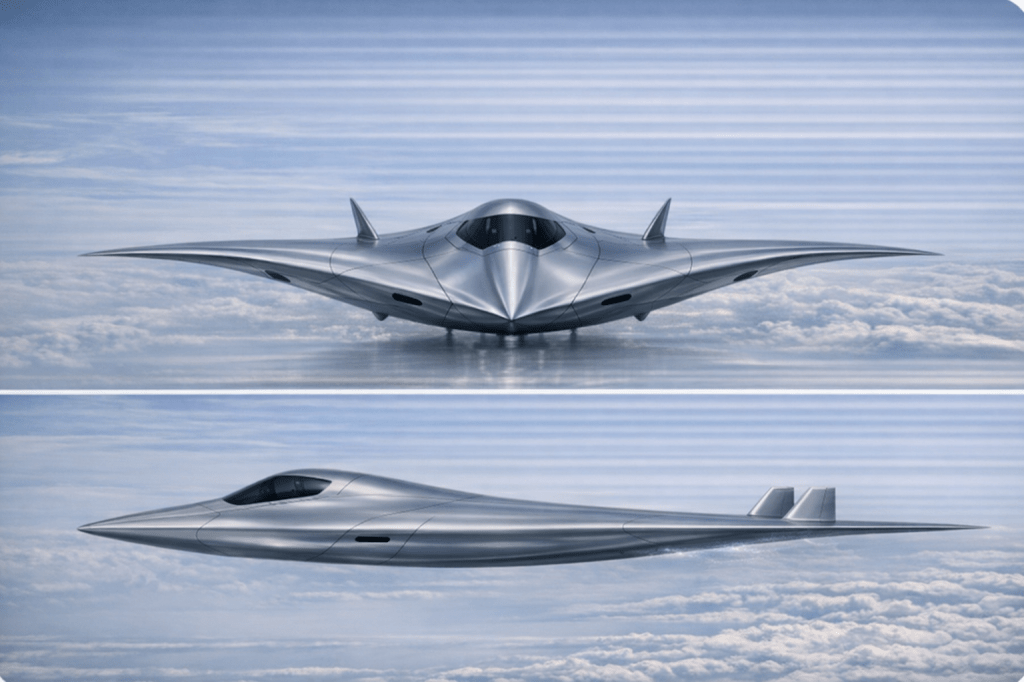
To accommodate the needs of generating lift with Fly By flux aircraft, the design was changed from those of the 20th and early 21st centuries. The new evolved design dispensed with the central fuselage supported by wings which also served as fuel tanks and lift generating devices. Newly developed Fly By Flux aircraft were based on the “flying wing” configuration and cruised at a very respectable Mach 2.0. The plan profile of these aircraft resembled an inverted V. The flight deck, which accommodated one pilot occupied the apex of the design. The performance of these aircraft improved with altitude for two main reasons; thinner air leading to less drag and a terrestrial magnetic field of greater uniformity.
With the new mechanical aspects of flight using this new ‘fuel’ approved and the associated aerodynamic designs which evolved from proofs of concept to working operational models, the avionics and associated electronics were then finalised. Fly By flux is the ultimate fly by wire technology and incorporated into every aircraft is a globally linked realtime learning neural network. Any problems encountered during operation are logged and transmitted to a central data collection base. AIRMETs, NOTAMs, Geomagnetic Activity, Kp Indices information and other operational critical data is disseminated to aircraft in the vicinity for pilots to assess and take necessary precautions to ensure safe operations continue.
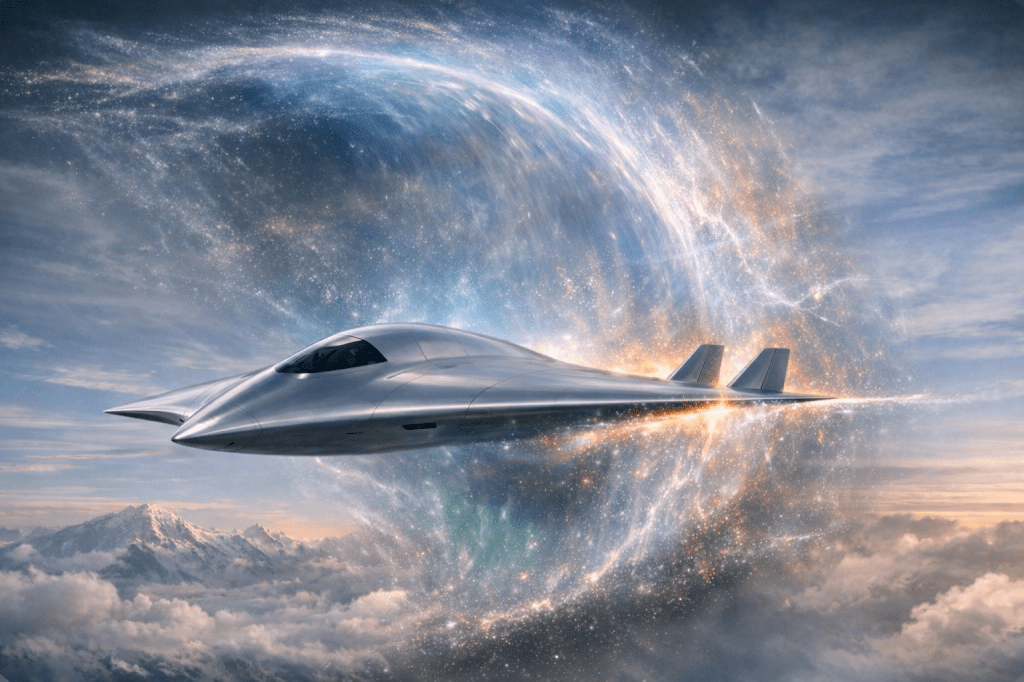
These aircraft were and still are truly spectacular and mesmerising to watch. A ground based observer, watching a Fly By Flux aircraft at altitude is treated to a display of iridescent, shimmering beauty. As each wingtip is at opposite electrical potential, it ionises the surrounding air producing hypnotic displays of St Elmo’s Fire. Both wingtips leave a trail behind them. These streaks eventually join behind the aircraft, at which point the trail of ionised gas dims. There were studies undertaken to investigate whether ionising the atmosphere would have a detrimental effect on the environment. During tests, JÖRD was satisfied when charged ions recombined behind the aircraft the air would once again be neutral so this effect would be transient with minimal consequence.
Although there is no engine noise associated with these aircraft, sonic booms are heard once the aircraft passes at high altitude. Aircraft closer to the ground travelling at subsonic speeds and within earshot of observers pass with a characteristic “whoosh”.
Not everyone was happy to see this new design’s arrival; oil companies suffered heavy financial losses, despite their attempts to mislead the world in believing there was no credible research to prove their viability. But public opinion would not be swayed and backed the team of boffins, who contributed to the salvage of Planet Earth.
Fly By Flux – A PIlot’s Perspective
Looking at historical records of aviation from the 20th and 21st centuries, Fly By Flux heralded a new piloting experience. Although familiar to our pilots here in the 23rd century, here are the main differences pilots from the last two centuries will experience if they were plucked from the flight decks of their vintage aircraft and immediately transported to our present day pilot environments.
Today’s experience on the flight deck begins with voice and retinal security checks and once complete, the systems begin to come on line. Lights and displays flicker as they run through their start up programs to ensure correct operation. A very faint whirring sound is heard as all the Teslators perform a pre programmed orientation cycle and finely tune themselves with the Earth’s local magnetic Flux.
Once the Fly By Flux aircraft knows where it is, the ‘success chime’, sounds and the pilot is now ready to fire up the Head Up Display, at which point he windscreen illuminates with programmed images which confirm the aircraft’s status and readiness for flight. Various pages and displays can be accessed to prepare for the flight ahead.
The pilot is then greeted with the aural prompt:
“Good day, XXX. All systems are online and are operating within expected tolerances. Will you be requiring MIND for any segments of this flight?”
At this point, the pilot is asked whether they wish to conduct the flight manually or under MIND (if the aircraft is MIND equipped) operations. Either or a mixture of both is available.
MIND used in the piloting aircraft and spacecraft and stands for Mind Initiated Navigation Device and is integrated on the most advanced flying machines. Sensors pick up thought patterns of the pilot and only commands within a certain frequency range are detected and actioned.
MIND is a great asset for flight planning. By ‘thinking’ the route, using NavAids and waypoints stored in the MIND database, the route is planned and later flown. Any new waypoints and NavAids can be programmed at any point and made available to all users anywhere in the world or in local spaceflight; local spaceflight being within the 3D space which comprises the orbits of Venus, Earth and Mars.
Once airborne with MIND engaged, the pilot performs tasks of varying complexity with the power of thought. Commands such as “gear up” or “divert due to unforeseen abnormal Jetstream activity” can be executed instantaneously and forgotten about, leaving the pilot to concentrate on other aspects of flight.
Airport Operations
Taxi Mode. Once clearance is received the Head Up Display immediately changes to reveal a moving map image depicting the journey from the terminal to the active runway. Other aircraft are shown along with information such as heading and speed. Colour codes are applied dependent on conflict potential. This system evolved from the earlier days of aviation, when ground based primary radar systems and TCAS (Traffic Collision Avoidance System) were used. Primary radar systems, such as ground radar, which relied on target reflections were prone to errors.
But our modern airports are retrofitted with ground based systems which pick up movements via the electrical grid necessary for Fly Bu Flux operations, using the Fleming Left Hand Motor rule principle. Smart transponders know each aircraft’s location and work with onboard computers to avoid conflict and incursions.
Once on the active runway the pilot sets the aircraft’s Teslators to maintain 90 degrees with the lines of flux during the departure and cruise. They run the elevons and systems through the test program to ensure correct operation during his departure.
Before the take off run the Air Drive Generators, (ADGs) are deployed to generate additional current during the take off run and departure should the aircraft suffer a total electrical failure which is incredibly rare.
Once cleared, the pilot eases the “throttle” forward which increases the current being fed through the undercarriage, which in turn interacts with the runway’s magnetic flux. The only sensation is the vibrations and probably the distant hum of the tyres on the runway. Apart from that, nothing.
At Vr, rotation speed, the pilot pulls back on the yoke. As the nose wheel leaves the runway, it does so with a spectacular flash of lightning as the electrical contact between the wheels and runway breaks, soon followed by the main gear. Once a positive rate of climb and increasing airspeed is confirmed the landing gear and ADGs are retracted. Fly By Flux was one of the main reasons global atmospheric destruction was avoided. Despite all the attempts by large corporations to safeguard their profits and fool the general public, the sentiment ‘one person can make a difference’ was validated as 1 person become 100, then 1,000, then 1,000,000, then 1,000,000,000 then 1 civilisation. Naturally many unscrupulous large businesses ceased to exist, governments fell and the GN (Global Nations) was formed to ensure the world never fell back into its previous ways.

